THE STRAIT OF FIRE: DAY 13 – THE WORLD HOLDS ITS BREATH AS THE HORMUZ CHOKES
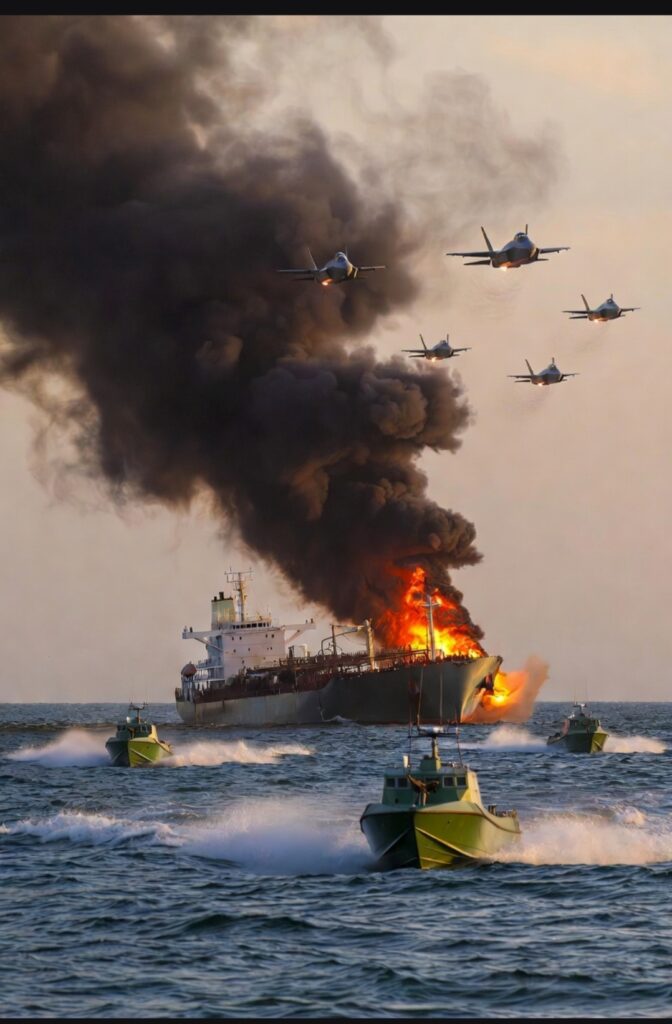
Garner, North Carolina, 11:49 AM EDT — Somewhere in the Persian Gulf right now, a 300-meter supertanker is burning. Black smoke towers thousands of feet into the sky while speedboats packed with Iranian Revolutionary Guard speed toward the next target. Oil prices just spiked another 14% in the last four hours. Global stock markets are bleeding red. And on the other side of the water, F-35s streak low across the waves, hunting radar sites that keep blinking back online no matter how many times they’re hit.
Welcome to Day 13 of the war nobody saw coming this fast.
What started as targeted Israeli strikes on Iranian nuclear facilities in late February has metastasized into the most dangerous maritime showdown since the Tanker War of the 1980s—only this time the United States is all-in, and the new Supreme Leader, Ayatollah Mojtaba Khamenei, just made his first public statement since taking power: the Strait of Hormuz isn’t closing… it’s weaponized.
Roughly 21 million barrels of oil — about one-fifth of the world’s daily supply — normally flow through that 21-mile-wide choke point every single day. Today, insurers are quoting war-risk premiums that make passage financially suicidal. Three more tankers were struck this morning; one is listing badly off Qeshm Island. Iran’s state media is already calling it “Operation Martyr’s Leverage.”
On the U.S. side, the Pentagon is unleashing what Defense Secretary Pete Hegseth called “the most intense 24-hour period of strikes yet.” Carrier Strike Group 5 (led by the USS Ronald Reagan) and the newly arrived USS Abraham Lincoln have turned the Gulf into a lightning storm of Tomahawk missiles and JDAMs. Iranian air defenses are crumbling—reports indicate at least 40% of their S-300 and indigenous Bavar-373 systems have been neutralized—but every time a battery goes dark, another pops up from underground silos carved into mountains.
Meanwhile, the new Supreme Leader’s statement this morning was chillingly clear: “The Strait is our red line. It will be used as leverage until the aggressors withdraw.” Translation: mines, anti-ship missiles, swarms of fast-attack boats, and possibly suicide drones are already being positioned. Shipping companies have rerouted everything they can around the Cape of Good Hope, adding weeks and millions in fuel costs to every voyage.
Here at home, gas pumps in North Carolina are already creeping toward $6.20/gallon, and the Strategic Petroleum Reserve is being tapped at emergency levels. President Trump is scheduled to speak this afternoon after a Medal of Honor ceremony, where he’s expected to double down: “Iran’s navy is gone. Their air force is gone. They can surrender tomorrow or we’ll keep going until they can’t threaten anyone ever again.”
But the math is brutal. Every day the strait stays semi-paralyzed, the global economy loses billions. Europe is scrambling for emergency LNG. China—quiet so far—watches its energy lifeline get squeezed. And in Tehran, hundreds of thousands marched last night chanting for vengeance, even as videos leak out showing devastated refineries and power outages stretching for days.
The wild cards keep stacking up:
Will Saudi Arabia and the UAE openly join the fight if more of their tankers are hit?
Can the U.S. Navy keep the strait open without a full amphibious landing?
And what happens if one “lucky” Iranian missile finds a carrier?
The world hasn’t stared down a genuine energy-war scenario this severe since 1973. Only this time the weapons are hypersonic, the drones are autonomous, and the stakes are planetary.
Buckle up. The next 72 hours may decide whether this stays a regional thunderclap… or becomes the spark that lights the 2020s on fire.